
Air monitoring is one of the most important safety tools in asbestos removal, but it is also one of the least understood. Most homeowners have never seen a monitoring report. They do not know what gets measured, what the numbers mean, or when monitoring is required versus optional.
This lack of understanding creates a gap. Property owners sign off on asbestos removal projects without knowing whether the air in their home was tested after the work was done. They receive clearance certificates without understanding what the numbers behind them actually tell you.
This guide explains asbestos air monitoring in plain terms. What it does, when it is legally required, how it works on site, and how to read the results.
What Does Air Monitoring Actually Measure?
Asbestos air monitoring measures the concentration of airborne asbestos fibres in a given area. The unit of measurement is fibres per millilitre of air (f/mL).
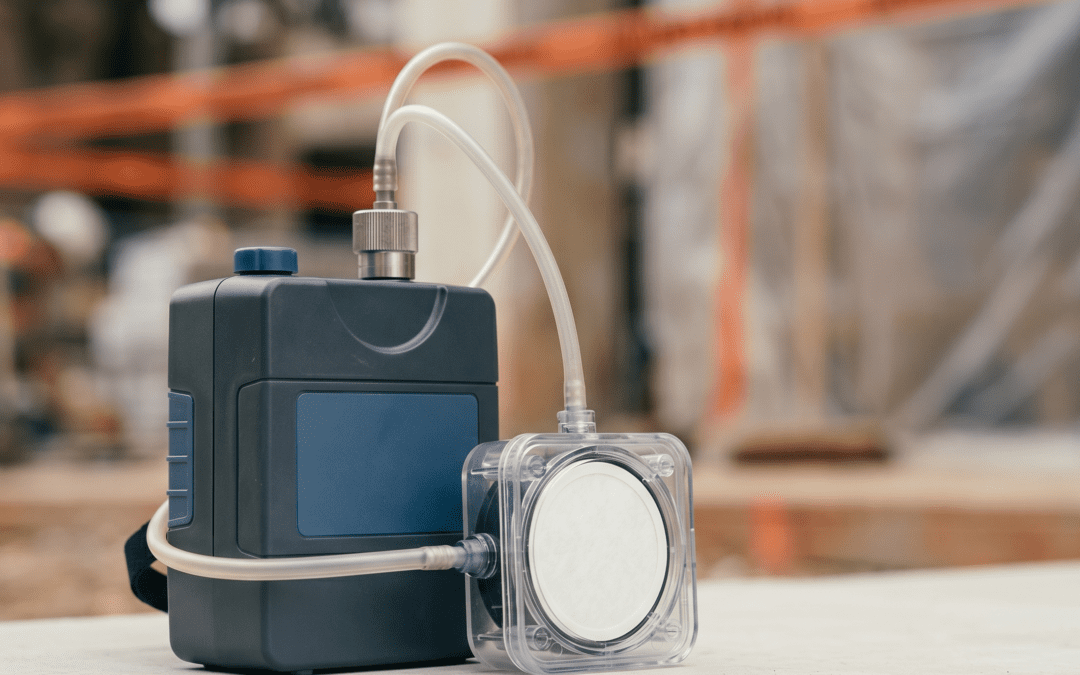
A small pump draws air through a filter at a controlled flow rate over a set period of time. The filter captures any fibres present in the air. After sampling, the filter is sent to a NATA-accredited laboratory where it is examined under a phase contrast microscope (PCM) or, for more detailed analysis, a scanning electron microscope (SEM).
The lab counts the number of fibres on the filter and calculates the concentration based on the volume of air sampled. The result is reported as a number of fibres per millilitre.
The key threshold in Australia is the workplace exposure standard of 0.1 f/mL, set by Safe Work Australia. This is the maximum allowable concentration for an 8-hour time-weighted average. For clearance monitoring after asbestos removal, the threshold is lower: 0.01 f/mL, which is the level that must be achieved before a work area can be declared safe for reoccupation.
When Is Air Monitoring Required?
The legal requirements for air monitoring during asbestos removal in NSW depend on the type of asbestos and the nature of the work.
Friable Asbestos Removal
Air monitoring is mandatory for all friable asbestos removal work. This includes background monitoring before work starts (to establish baseline fibre levels), exposure monitoring during the removal (to check that controls are working), and clearance monitoring after the removal is complete and the enclosure has been cleaned (to confirm that the area is safe).
Clearance monitoring for friable asbestos must be conducted by a licensed asbestos assessor who is independent of the removal contractor. This independence is a legal requirement. The company removing the asbestos cannot also be the company certifying that the air is clean.
Bonded Asbestos Removal
Air monitoring is not always legally required for bonded (non-friable) asbestos removal in NSW. However, it is recommended in situations where large quantities of bonded asbestos are being removed, the material is in poor condition or may become friable during removal, the work is being done in an enclosed or poorly ventilated area, the property will be reoccupied immediately after the work, or the property owner or project manager requests it.
Many reputable asbestos removal companies offer air monitoring as a standard inclusion on larger bonded removal jobs, even when it is not strictly required. It provides an extra layer of assurance for the property owner and creates a documented record that the work was done safely.
During Demolition
When a home demolition or commercial demolition involves asbestos removal as part of the process, air monitoring may be required by the project’s asbestos removal control plan or by the council’s conditions of consent. For demolitions involving friable asbestos, monitoring is always required.
How Air Monitoring Works on Site
Here is what happens on a typical asbestos removal job where air monitoring is being conducted.
Before the Work Starts
The licensed asbestos assessor (also called an occupational hygienist or air monitor) arrives before the removal crew begins. They set up background monitoring pumps at locations around the work area, including downwind positions and near any occupied areas. These pumps run for a set period to measure the existing fibre levels in the air before any asbestos is disturbed.
Background levels in most outdoor residential settings are extremely low, typically below the detection limit of the test method. This baseline reading becomes the reference point for all subsequent results.
During the Removal
For friable asbestos removal, monitoring pumps run continuously during the work inside and outside the enclosure. Personal monitoring pumps may also be attached to the removal workers to measure their individual exposure levels.
The assessor checks the pumps regularly, records observations, and may adjust sampling locations if conditions change (for example, if wind direction shifts on an outdoor job).
For bonded asbestos removal where monitoring is included, the setup is similar but typically involves fewer sampling points, since the risk of fibre release is lower.
After the Removal
Once the removal is complete and the work area has been cleaned, clearance monitoring begins. For friable asbestos jobs, this happens inside the enclosure after the final clean but before the enclosure is dismantled. The pumps run for a minimum period (typically at least 4 hours for a standard clearance) to collect enough air volume for a reliable result.
The filters are then sent to the laboratory for analysis. Results are usually available within 24 to 48 hours.
Clearance
If all clearance monitoring results are below the 0.01 f/mL threshold, the assessor issues a clearance certificate. This certificate confirms that the area has been inspected, cleaned, and air-tested, and is safe for reoccupation or further construction work.
If any result exceeds the threshold, the area must be re-cleaned and re-tested until compliant results are achieved.
How to Read an Air Monitoring Report
An air monitoring report from a licensed assessor will include several key pieces of information.
Sample location: Where each pump was placed (inside enclosure, outside boundary, downwind, nearest occupied area, etc.).
Sampling duration and flow rate: How long the pump ran and at what rate. These numbers are used to calculate the total air volume sampled.
Fibre count and concentration: The number of fibres found on the filter and the calculated concentration in f/mL.
Comparison to the threshold: Whether each result is below the clearance standard of 0.01 f/mL (or the workplace exposure standard of 0.1 f/mL for exposure monitoring).
Assessment outcome: A clear statement of whether the area has passed or failed clearance.
When reviewing a report, the key number to look for is the fibre concentration in f/mL at each sampling location. If all results are below 0.01 f/mL, the area is considered safe. If any result is at or above 0.01 f/mL, additional cleaning and re-testing is required.
Some reports will show results as “less than” a certain value (for example, <0.01 f/mL). This means the fibre count was below the detection limit of the test method, which is the best possible result.
Why Air Monitoring Matters to You as a Property Owner
Even if you never read the detailed report, the existence of air monitoring data protects you in several ways.
Health assurance: It confirms that the air in and around your property was tested and found safe after asbestos removal. This is especially important if your family is living nearby during the work, or if the property will be reoccupied immediately after.
Legal compliance: For friable asbestos removal, a clearance certificate backed by air monitoring results is a legal requirement. Without it, the removal is not considered complete under NSW regulations.
Documentation for sale: When you sell the property, the air monitoring report and clearance certificate demonstrate that asbestos was managed properly. This gives buyers confidence and reduces the risk of disputes or price adjustments.
Protection against disputes: If a neighbour, tenant, or future occupant raises concerns about asbestos exposure, your air monitoring records provide evidence that the work was conducted safely and the area was cleared to the required standard.
Questions to Ask Your Removal Contractor About Air Monitoring
Before your project starts, ask these questions:
Will air monitoring be conducted during this job? If so, who will do it? Is the air monitor independent of the removal company? Will I receive a copy of the air monitoring report and clearance certificate? What happens if a clearance test fails?
A reputable contractor will answer all of these clearly. If air monitoring is not included and your job involves anything more than a small bonded removal, ask why, and consider requesting it as an addition.
If you are planning an asbestos removal project in Sydney and want to make sure it is done with full monitoring and documentation, contact us for a quote. We will walk you through the entire process and make sure you have the records you need.